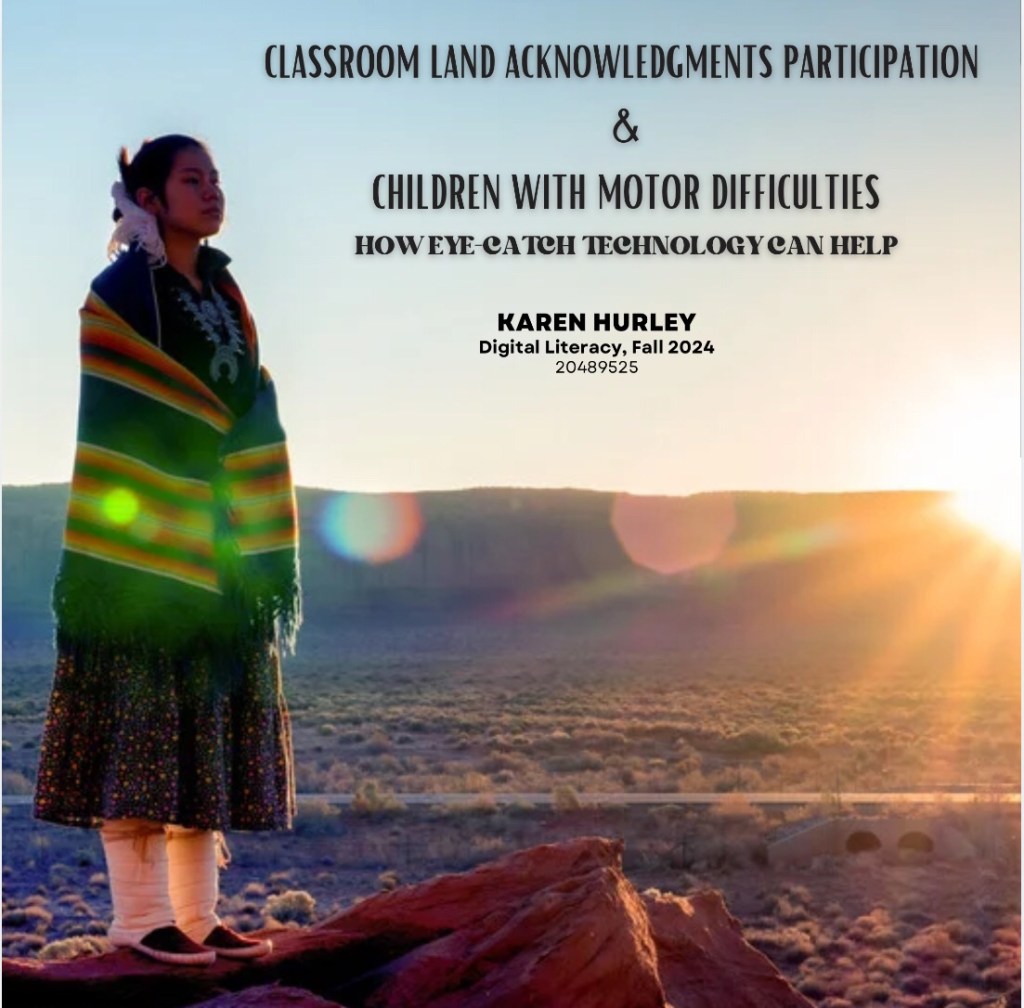
Inclusion is about engendering a sense of community and belonging.
Department of Education & Skills, Inclusive Schooling
My inspiration for this blog
Transforming “assistive” technology into “educational” technology”
In September, the week my daughter started Senior Kindergarten, my friend, who works for the Ottawa Catholic School Board as an itinerant teaching of the hearing impaired, sent me an image. It was an image of an elementary school land acknowledgement, written entirely, in the Picture Exchange and Communication system (PECS).
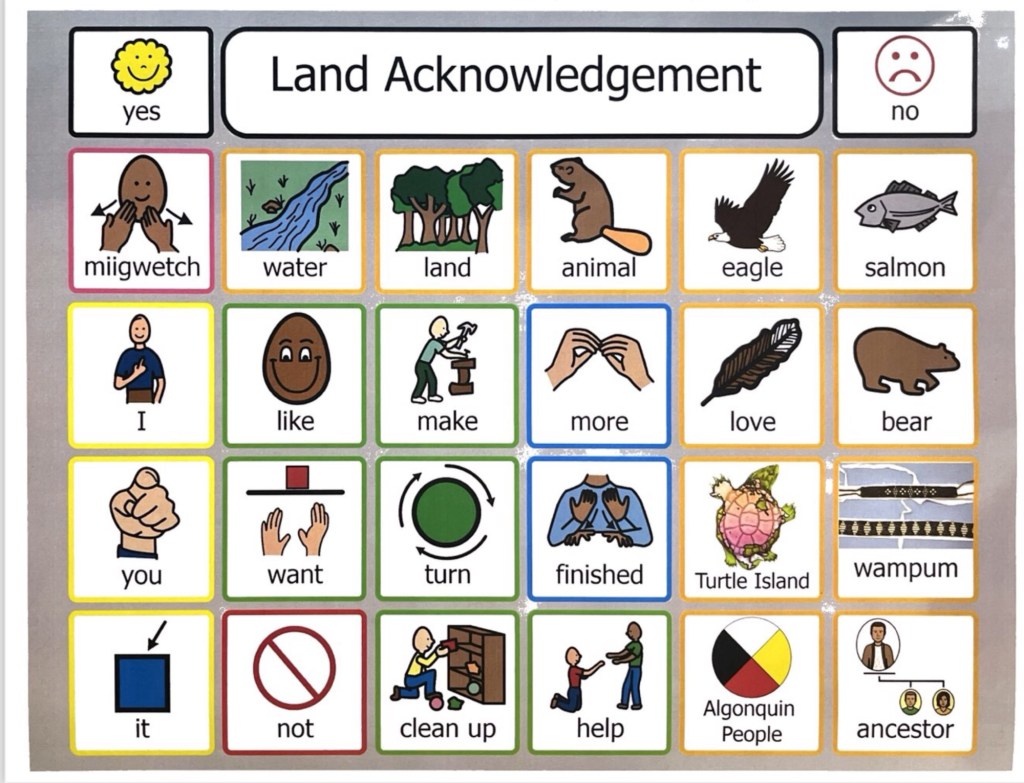
PECS are often referred to as “a way for autistic people to communicate without relying on speech” (The Australian Parenting Website, para 3). However PECS a is actually an Augmentative and Alternative Communication (AAC) device for anyone, of any age. It used for a range of speech differences … apraxia due to Cerebral Palsy is an example, as is aphasia due to a brain tumour of traumatic brain injury.
My four-year-old was diagnosed at the age of two with a rare and interesting neurological disorder. I had asked for a referral to a developmental pediatrician. I had been noticing that as my daughter would attempt to repeat a word, but it would come out completely different the what she was trying to say. For example, I would say “I wonder if we will see any cats on our walk today.” She heard the word, she knew what it meant, but as soon as she saw a cat she would point to it … and a completely different sound would come out, such as “task”. Or, I would say “time to brush your teeth” at night, or “time to brush your hair” in the morning … knowing exactly what that meant, my daughter would grab the correct brush, but hold it upside down when she brushed. The diagnosis was global apraxia: the inability to execute a normal, voluntary motor movement … despite being able to demonstrate normal muscle function (Smith, 2014).
My daughter and I had just finished six months of training with the Children’s Hospital of Eastern Ontario’s AAC clinic. My daughter has started junior kindergarten, with an AAC device – an iPad mini with the application Prolquo2Go on a harness she wore across her chest. She was only one of two students at the school with an AAC device, and the other student was in his last year of elementary school school. My daughter’s device went from a harness daily, to sitting beside her on her desk, to being in a drawer at the teacher’s, to not coming out of her backpack at all.
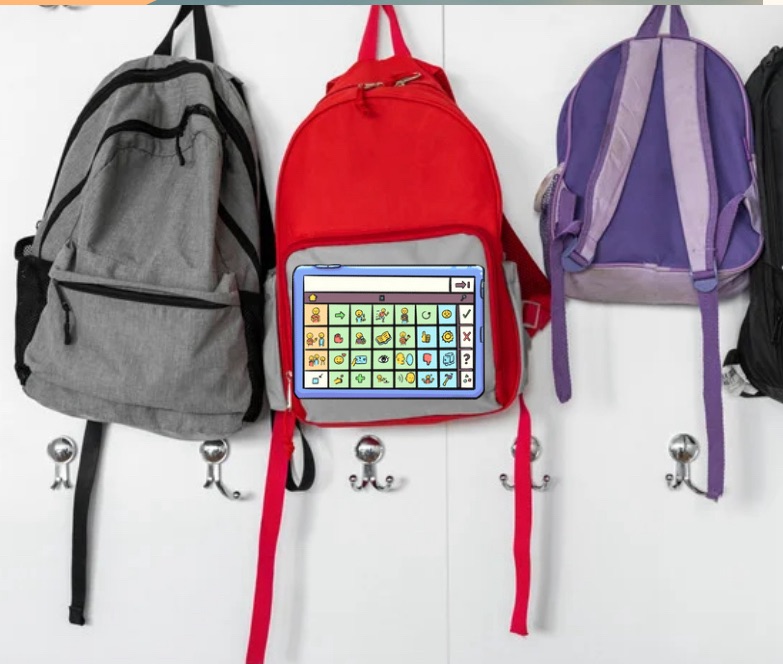
My friend knew that I was looking for a way to normalize the use of AAC in kindergarten, and offered the PECS land acknowledgment, which was said often in the classroom. I chatted with the kinder teachers about how I could input the page on her iPad, and she could voice the acknowledgement along with her peers. The page of PECS could also be at the front of the classroom on a poster, I thought, with the corresponding words of the acknowledgment written below them.
This would seem to accomplish the approach author Christopher Bugaj’s suggests in his text The New Assistive Tech. Bugaj suggests assistive-design facilitators familiarize all students in a classroom with the education technology of their peers with additional needs – so that all students are using the applications and they become “educational” and not “assisstive” (Bugaj, 2018). The technology thereby becomes a way Tim enhance every student’s learning experience, not just a way to support the members of the class who have learning difficulties.
I think it it’s important to note that many who wrote the original land acknowledgments for Canadian institutes of learning regret aspects of their creations.

Hayden King, for example, wrote the Toronto Metropolitan University’s land acknowledgement. He now feels that reciting land acknowledgements now feels superficial (Rudder, 2019). In an interview with CBC News, King says that rote recitation of land acknowledgements “obscures the fact that these treaties are real institutions and not metaphors” (Rudder, 2019).
It is important to note, when reading the above land acknowledgment and reflecting on it, that “Ryerson University” is the former name of the Toronto Metropolitan University. The name was changed in 2022. This was done because its former namesake was Egerton Ryerson. Egerton Ryerson was considered an architect of the Canadian Residential School System (Griffin, 2023)
According to King in his interview, land acknowledgments “are usually scripted and read off by the speaker” (Rudder, 2019).
Olson Crow, the first indigenous representative on the university’s student union, agrees. He states educational institutions have make the reading of land acknowledgments “something that makes it a simple read-off” by the classroom teacher (Rudder, 2019).
Indeed, taking a classroom’s land acknowledgment and making tailoring to adjust to the differing abilities of all students on a class would make it more than a superficial read-off. It would, as Olson seeks, turn it into something more personal (Rudder, 2019) . It would place the students directly into the acknowledgment. The students would be connected as a classroom, in all its individual uniqueness, to the land that everyday they gather on to learn and play.
The POUR Principle Problem
While there is a small percentage of apraxic children who only have apraxia of speech – the vast majority also have a wider-ranging motor difference. With time limitations plus inaccessible elements (touch screen, using a mouse), it would be extremely challenging if not completely impossible for a student with severe motor recite to recite a land acknowledgment alongside their classmate with the current AAC technology.
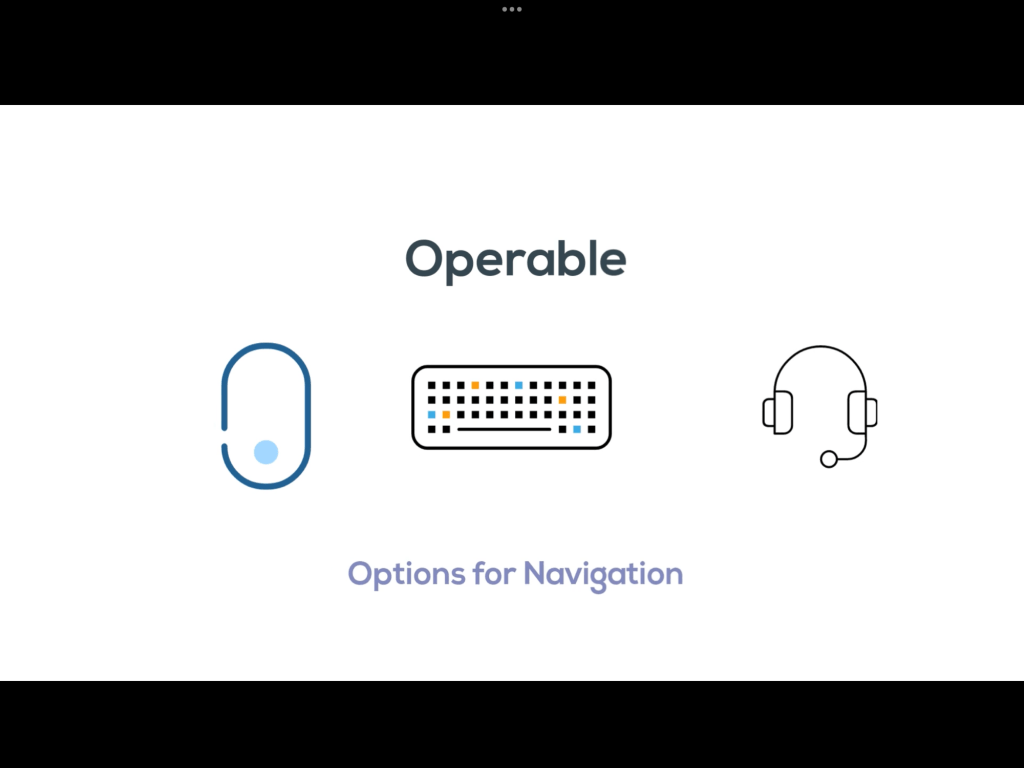
The POUR principle points to a problem with AAC technology and the use of AAC devices in the classroom so that all can participate in a land acknowledgments. The “O” in POUR stands for operable: this means interface is is truly navigable to all users (National Centre for Accessible Materials, para 2). For example, 17% of children with CP also have apraxia of speech. 82% of children with CP have disordered speech production. But, in her blog “Apraxia and Cerebral Palsy: How are they linked?”, the CP Family Network writes that cerebral palsy also affects a wide range of range of other motors abilities, such as balance, posture, and speech (CP Family Network, 2024).
Applications, Eye Tracking, and Operability for Students with Motor Differences
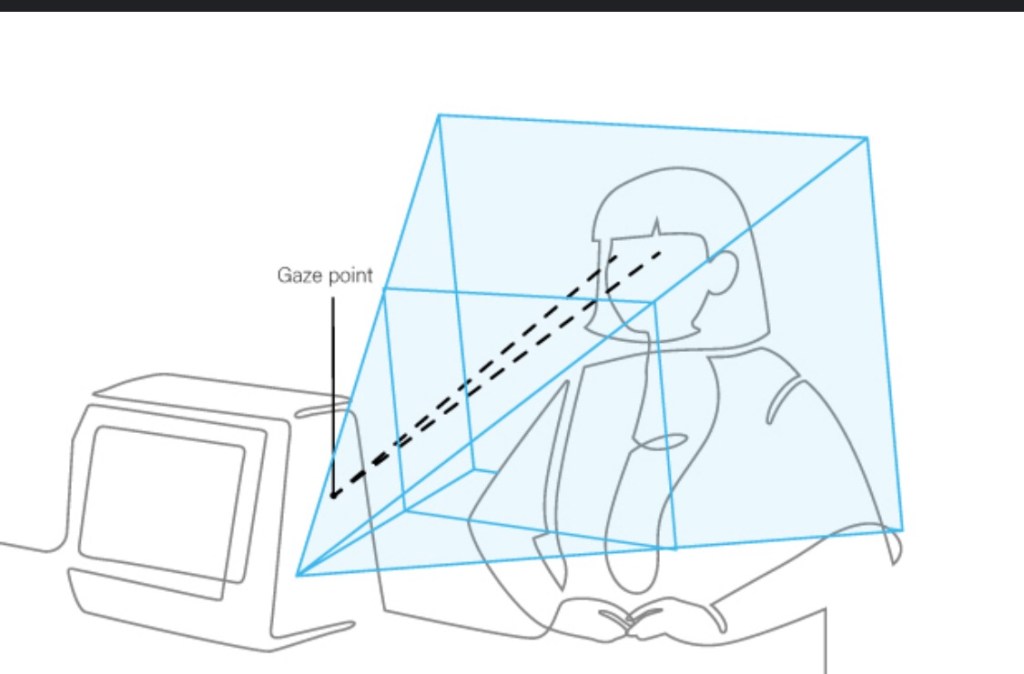
Eye tracking technology’s uses specialized cameras. These cameras enable people with motor disabilities to control devices such as iPads and other commonly used AAC devices with eye movements. In May this year, Apple announced eye tracking as a way for users with motor differences to control their iPad’s applications using their eyes (Apple Press Release, 2024). Eye Tracking works across IPadOS applucations – users can press physical buttons or swipe across a screen solely with their eyes (Apple Press Release, 2024).
If provincially-funded clinics, such as CHEO’s AAC clinic, begin ensuring applications used on AAC devices have eye tracking technology, then it followed that users with communication disorders, such as apraxia, could follow with classroom recitations, such as of a land acknowledgement.
Taking this one step further, school boards should begin to ensure all their classroom technology – not just AAC devices set up by hospital programs for individual students – has eye tracking technology. Then this technology , which makes applications operable for those with motor impairments, would become a part of curriculum learning and be viewed as educational technology and not assistive, supportive, augmentative, or augmentative technology.
References
Apple Newsroom. “Apple Announces
new accessibility features, including
Eye Tracking, Music Haptics, and Vocal
Shortcut.” (Press Release, 2024).
apple.com
The Australian Parenting Network. “What is
the Picture Exchange Communication
System?”.
raisingchildren.net.au
Bugatti, C. The New Assistuve Tech: Make
Learning Awesome For All. International
Society for Technology in Education, 2018.
The CP Family Network. “Apraxia and
Cerebral Palsy: How Are They Linked?”
cpfamilynetwork.org
Griffin, T. “Toronto Metropolitan
University Reflects on new name change
one year later”. (The Canadian Press, 2023).
globalnews.ca
National Centre on Accessible
Educational Materials. “Designing for
Accessibility”.
aem.cast.org
Rudder, Kiara. “Hayden King and others
question the effectiveness of
land acknowledgments”. The Eye
Opener: 2019).
theeyeopener.com
 Site Title
Leave a comment